
Since the AI boom, one question keeps coming up in interpreting too: human or AI? We think it's the wrong question.
Because when a client calls us, it's never about a principle. It's about one specific event, with its own audience, its own content, its own schedule. And the answer comes out differently every time.
So the first question in a consultation isn't whether AI is an option. It's this: what actually happens at this event? Is one person doing most of the talking, or are six people discussing with rapid changes of speaker? Almost everything else follows from that distinction.
Not all AI is the same
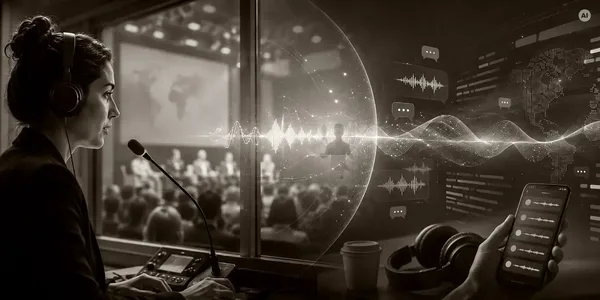
For discussions with frequent changes of speaker, we output the interpretation as text – Speech to Text. The delay is two to three seconds. Participants read along on their own phone via QR code, in a browser, on a second screen or as subtitles on the projection. For a panel where three people talk over each other, that's the more usable option. If you're reading, you don't lose the thread when the next speaker has already started.
For speeches, presentations, keynotes and webinars, we output the interpretation as audio – Speech to Speech. It takes longer, roughly four to six seconds, but delivers better results and can be listened to through headphones instead of read. The average delay of 4.1 seconds is roughly the range human interpreters work in.
So the format decides which kind of AI fits. Whether AI fits at all is decided by something else: how much rides on the content.
When people are the better choice
For a three-day specialist conference with panel discussions, questions from the floor and speakers who depart from their script, we recommend professional interpreters. Not on principle, but because everything that makes interpreting difficult comes together there: specialist terminology, cultural references, irony, speakers who mumble, a change of topic that was on no agenda. People prepare for a subject. They notice when a sentence hasn't landed. They can react.
For a 90-minute product launch with three guests from Spain in the audience, the calculation looks different. Here AI makes a language possible that wouldn't have been offered at all, because the effort for three people wouldn't have paid off.
And in many cases it's both. One language channel is staffed with human interpreters, further languages are added via AI. The output is mixed: conventional receivers and headphones for the main languages, phone or browser for the rest.
Preparation makes the difference
AI interpreting isn't perfect, and we don't claim otherwise. What makes it considerably better is preparation. We load up to 500 key terms and up to 500 terms that should stay exactly as they are. Product names. Abbreviations. Company names that would otherwise end up as an ordinary word in the target language.
At an event with a lot of specialist vocabulary, that glossary decides the quality – not the question of which system is running.
Where we advise against AI
Board and committee meetings. Negotiations. Medical and legal content. Anything where a single sentence has consequences and where what's said must not leave the room.
Technically it could be done: the servers are in Europe, the system is secured in line with the GDPR, recordings and transcripts are deleted after 30 days, sooner on request. We still advise against AI for formats like these. There, price is the second question, not the first.
Three questions for...
Nils Fuchs is Project Manager at The Cue Group Berlin – Team PCS. Among other things, he plans multilingual events. That puts him in the conversations where it's decided whether an event gets interpreting booths, an AI channel or both.
1. How do you tell what an event really needs linguistically?
The purpose, first. Is this specialist discussion, an informal get-together or really just small talk? Then I look at the stage. Is one person standing at a lectern, or do five people take turns on a panel and switch between two languages while they're at it?
The room gets underestimated. Poor acoustics, background noise, an audience that talks along – that's harder for AI than any specialist subject. A microphone signal with half the room behind it pushes every system to its limit.
And I ask early on whether there's material. If there's a glossary and scripts, my recommendation looks different than with an agenda of five bullet points.
2. What's at stake when communication doesn't work?
In the worst case, a scandal.
When a political message lands wrong, nobody in the room may notice at first. The damage comes later, when someone is quoted saying something they never said. A professional interpreter doesn't just interpret, they place things in context: historically, politically, technically. They know which phrasing carries baggage in which country and which doesn't.
3. What has actually changed in multilingual events over the past three years – not in the debate about it, but in daily practice?
English is becoming more and more of a given as a business language. As a result, smaller meetings increasingly do without simultaneous interpreting altogether, usually to save costs. The two or three participants whose English isn't quite good enough then simply sit there and understand half of it.
That's exactly where something has shifted. For that small group, an AI channel pays off today that would never have been in the budget before. Once it's set up, a large number of languages are available immediately.
What an interpreter makes of AI
Elena Sander interprets at appointments with notaries, courts, public authorities and hospitals. There, interpreting doesn't accompany a programme – it accompanies a signature, a diagnosis, a statement.
I have it produce summaries and terminology lists, answer questions, draft explanations.
For written assignments I use it every day. I ask how terms differ and which one fits where, for better translation suggestions, for spelling mistakes. That has made my work considerably easier and faster. I no longer commission proofreading at all, which saves me time and money.
Planning a multilingual event?
We'll advise you on which form of interpreting suits your format – and supply the technology to go with it. Interpreting booths, language channels and receivers, as well as sound, lighting, video, streaming and on-site support.