
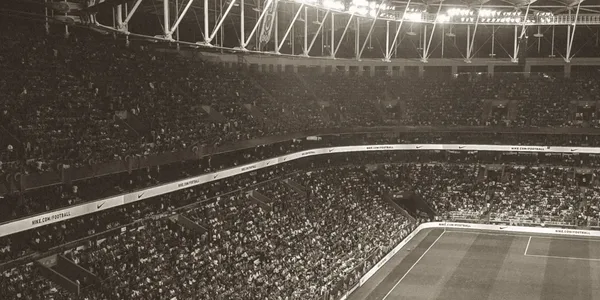
Public viewing in the rain: which outdoor tech actually holds up
90th minute. Extra time. A hundred people standing shoulder to shoulder, eyes on the screen.
Then the rain starts.
Not the kind that stops after two minutes. The other kind. The kind that makes you pause and wonder if you should really go through with it.
And that's the moment that decides whether the public viewing becomes a good memory - or the event where everything fell apart.
You can't plan the mood. You can plan the tech.
So what does an outdoor public viewing actually need to hold up when it rains?
Outdoor doesn't automatically mean weatherproof
This is the mistake people make the first time around: they rent equipment that "seems" made for outdoor use, then find out that splashing water, humidity, and a sudden downpour speak a different language than the spec sheet does.
Being outdoor-rated doesn't automatically mean weatherproof. And being weatherproof doesn't automatically mean the picture still looks good in the rain or in daylight.
If you're planning a public viewing that needs to work no matter what the weather does, you need to be deliberate about the event technology you choose - not just go with your gut.
The biggest problem: visibility in bad weather
Rain brings clouds. Clouds bring diffuse light. And diffuse light is the natural enemy of any display that isn't built for it.
A regular LED screen that looks perfect in a dark hall suddenly looks pale and hard to read outside under an overcast sky. Direct sunlight makes it even worse.
The key number here is brightness, measured in nits.
As a rough guide for outdoor use:
- From 3,000 nits - enough for overcast skies and evening events
- From 5,000 nits - recommended for daytime use and changeable weather
- From 7,000 nits and up - needed for direct sunlight and peak summer conditions
Cutting corners here is cutting corners in the wrong place. A screen nobody can actually see doesn't do its job - no matter how well everything else is organized.
LED wall or projection screen - which one wins outdoors?
Short answer: for genuine outdoor use, it's almost always the LED wall.
Projectors and screens have a fundamental problem outside: they need darkness. As soon as ambient light enters the picture - and at an open-air event, it almost always does - the image loses contrast and brightness. What looks brilliant indoors quickly turns pale outdoors under a cloudy sky.
A quality LED wall produces its own light. Instead of fighting the ambient light, it simply outshines it. That makes it the more reliable choice for events where the weather shouldn't be allowed to matter.
On top of that, modern outdoor LED walls are certified to specific IP ratings - they're built for rain and moisture from the ground up, not just covered up as an afterthought.
Want to stay in the loop?
Subscribe to our newsletter.
IP ratings: what the numbers actually mean
IP stands for Ingress Protection - how well a device is sealed against water and dust. The first digit covers dust protection, the second covers water protection.
For outdoor public viewing equipment, these are the ratings that matter:
- IP54 - protected against splashing water from any direction. Fine for light rain with a stable setup.
- IP65 - protected against water jets. Recommended for events with unpredictable weather.
- IP67 / IP68 - protected against temporary submersion. Rarely necessary, but found in premium gear.
One thing to keep in mind: the IP rating applies to the device itself - not to cable connections, power outlets, or mounts. The whole technical chain needs to be weatherproof, not just the screen.
What people usually forget about public viewing equipment
Sound outdoors
Sound behaves differently outside than in an enclosed space. What sounds great in a hall gets lost quickly outdoors, especially once wind is added to the mix.
For open-air setups, line array systems or well-placed delay speakers are the way to go - they spread the sound evenly across the crowd. That way, people at the back hear every roar too, instead of just a dull rumble in the distance.
Power and safety
Water and electricity outdoors is serious business. Every connection needs to be rated for outdoor use and protected against moisture - cables, connectors, and distribution boxes alike.
Professional outdoor event technology relies on splash-protected power distributors and cable bridges that stay safe to walk on even in the rain.
Structure and stability
An LED wall spanning several square meters acts like a sail in the wind. Wind load has to be factored into the build - especially when there's no sheltered spot to work with.
Solid trussing, proper anchoring, and a weather forecast that actually feeds into the planning aren't extras. They're the baseline.
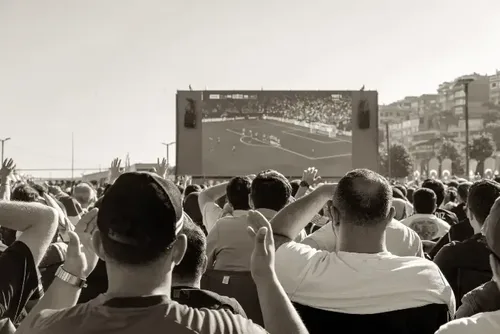
How much protection does the rest of the setup need?
The LED wall and speakers are visible, so they usually get planned with the weather in mind. What often gets overlooked: the equipment behind the scenes.
Media servers, signal distribution, and control units are often placed under a tent. But moisture can still be a problem there too - from condensation, driving rain, or just humid air building up over several hours. If you want to be safe, plan a weatherproof setup for the control area as well.
Checklist: public viewing tech for bad weather
- LED wall rated at least IP54, ideally IP65, for outdoor use
- Brightness from 5,000 nits for daytime or overcast conditions
- Line array or delay speakers for even sound coverage outdoors
- Weatherproof power supply - cables, connectors, and distributors all checked
- Wind load calculation for screens and truss structures
- Protected control area - secure the media technology behind the scenes too
- Use projection technology only for evening events without direct sunlight
The takeaway: rain is predictable, a bad atmosphere doesn't have to be
A public viewing that falls apart at the first downpour isn't bad luck. It's a planning gap.
Choose the right components, know your IP ratings, and treat the entire technical chain as weatherproof - and your football public viewing can hold up even when the weather doesn't.
You can't control the weather. You can control the tech.
And when the next big tournament rolls around - Euros, World Cup, Champions League final - the real question isn't will it rain?
It's are we ready if it does?
The Cue Group plans and delivers public viewing events for outdoor gatherings of any size - weatherproof, reliable, with full on-site technical support. More on the video technology we use.
You might also be interested in: