
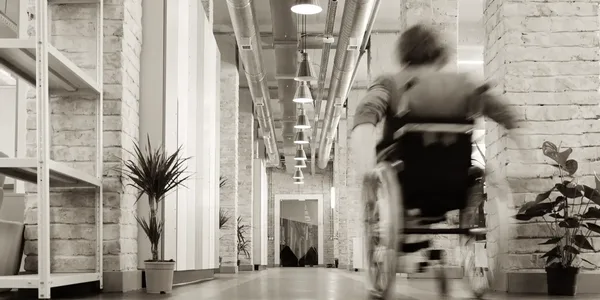
"We already have a ramp at the entrance – that's enough." This sentence comes up in event planning more often than you'd think. Accessibility is still too often reduced to structural questions, when real participation is decided somewhere else entirely: in the sound system, in the captioning, in whether a deaf attendee can follow the talk at all. An accessible event is one where nobody has to ask for extra help to keep up. That's exactly why inclusive event planning doesn't start on event day – it starts long before, with the choice of venue, the run of show, and the budget.
Why this topic is becoming more urgent right now
he German Accessibility Strengthening Act (BFSG) has been in force since June 28, 2025. For organizers, it primarily affects the digital components of an event – ticketing, registration platforms, livestreams, and hybrid formats must be accessible. Purely in-person formats without online booking are less directly affected, but the trend is clear: anyone planning conferences or corporate events today can hardly avoid the topic.
A hybrid session of the Inclusion Advisory Council at Germany's Federal Ministry of Labour and Social Affairs in Berlin shows what this can look like in practice: PTZ cameras automatically switch between speaker and plenary, a sign language interpreter appears via video overlay, live captions run in parallel. The result: remote attendees aren't just following along acoustically – they follow what's happening in the room just as closely as people on site, a setup that also works well for hybrid conferences with a streaming component.
How do you make an event technically accessible?
Four technical building blocks can usually be combined, depending on the audience's needs:
- Induction loops (hearing loop systems) transmit sound directly and without interference to hearing aids or cochlear implants with a T-coil – either permanently installed in the floor or set up as a mobile ring loop around individual rows of seating
- Live captioning via CART writers or AI-powered speech recognition, displayed on screen, on a monitor, or via QR code directly on a smartphone, with no app download required
- Sign language interpretation, either live on site or via video overlay – the latter saves travel time and integrates cleanly into an existing interpretation and simultaneous translation setup
- Screen reader compatibility for the registration platform and streaming interface, sufficient contrast on slides, and full usability without a mouse
All four building blocks can be combined as part of an inclusive event technology package – individually or as a complete package, tailored to venue and format.
Thinking organizationally: retrofitting costs more than planning ahead
The technology is solvable – the bigger lever is usually organizational:
- Choosing a venue with step-free access, elevators, and wide pathways in mind – checked before booking, not after
- Booking CART writers and sign language interpreters early – good specialists are booked out weeks in advance
- Briefing speakers: pacing, eye contact with the camera in hybrid formats, no purely visual references without a verbal description
- A registration form with a field for individual needs (induction loop, sign language, wheelchair space)
- Setting a realistic budget – accessible technology is cheaper when it's part of the concept from the start, rather than retrofitted at short notice
Anyone who doesn't want to take on the full technical responsibility themselves can hand these points over to a full-service event planning provider who factors in accessibility from venue selection through to execution.

Want to stay in the loop?
Subscribe to our newsletter.
Which solution fits which need?
Hearing impairment
Induction loop / hearing loop system, useful for in-person formats with an audience. Sound is transmitted directly and without room echo to hearing aids or cochlear implants with a T-coil. Important: the loop has to match the size of the room, or dead zones appear in the audience.
Tech tip: For rooms over 200 people, a multi-channel loop system with separate amplifier zones is preferable to a single ring loop – this keeps signal quality stable even in the back rows.
Deafness
Live captioning + sign language interpreter, useful for in-person and hybrid formats. Captions alone are often not enough, since German Sign Language has its own grammar and doesn't map 1:1 onto written language. Both solutions complement each other but cover different needs.
Tech tip: A dedicated, well-lit camera feed for the interpreter is worth the investment instead of a small overlay in the production feed – this keeps facial expressions and handshapes clearly visible in the stream.
Visual impairment
Audio description, high contrast, screen reader compatibility, useful for digital components and presentations. It's essential that slides are explained verbally, not just visually – purely visual references like "as you can see here" exclude this audience.
Tech tip: An additional audio channel for live audio description can easily be fed in via a separate receiver channel on the conference technology, with no interference to the main audio.
Cognitive impairment
Plain language, structured run of show, useful for all formats. A clearly communicated schedule with fixed breaks and simply worded registration materials helps not just this audience, but improves clarity for everyone attending.
Tech tip: A digital schedule on foyer monitors that updates live and displays the next program item provides extra orientation – with no printed material needed.
Limited mobility
Step-free pathways, reserved seating, useful for venue planning. This also includes sufficiently wide passageways, an accessible restroom within easy reach, and seats with a clear sightline to the stage, not just at the edge of the room.
Tech tip: Reserved seats can be marked with discreet floor markings that blend into the stage design, instead of conspicuous barrier tape.
Accessible wayfinding
Accessibility doesn't end at the entrance. Clear signage with pictograms and short, well-signposted routes to accessible restrooms are just as much a part of planning as induction loops or live captioning. The restroom question in particular is often overlooked, yet for many attendees it's the very first question they have.
Tech tip: Tactile floor guidance systems can be laid as a sturdy adhesive strip for temporary events, with no structural intervention in the venue's floor.
None of these solutions works best in isolation. Usually it's the combination of two or three building blocks that makes an event truly accessible to the widest range of attendees – tailored to format, audience, and venue.
Conclusion
Accessibility can't be checked off with a ramp at the entrance – it's decided by the sound system, the captioning, and how early it's factored into the planning process. Anyone who builds inclusive technology in from the start, instead of retrofitting it at short notice, doesn't just save budget – they also reach noticeably more attendees. Whether it's an induction loop, live captioning, or sign language interpretation: the right solution depends on the format and the audience – and turns an accessible event into one that truly everyone can take part in.
FAQ
Through a combination of an induction loop for hearing support, live captioning or CART writing, sign language interpretation where needed, and an accessible digital infrastructure for registration and streaming. The key is planning these building blocks in during the concept phase, rather than retrofitting them at short notice.
Alongside classic induction technology, QR-code-based live captioning systems have become established, working on attendees' own smartphones with no app installation required. For sign language interpretation, hybrid formats often just need an additional camera feed in the production setup.
Since June 2025, the BFSG has applied to the digital components of events, such as ticketing and livestreams. Purely analog in-person formats are subject to different, partly state-level regulations. It's worth checking early which requirements apply to your specific format.