
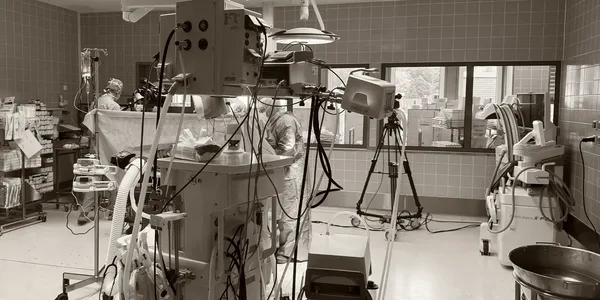
A live surgery broadcast places unique demands on both people and technology. Medically relevant images are transmitted directly from the operating room to a lecture hall in real time. Every element must function flawlessly without disrupting the surgical procedure itself.
In medical education, success depends on more than just good technology. Experience, composure, preparation and a clear understanding of the environment are equally important.
A live surgical transmission is not a typical event production. In the lecture hall, everything should appear clear, understandable and calm: the video feed, audio, audience questions and medical signals. Inside the operating room, however, reality looks very different. Space is limited. Hygiene regulations are strict. Sterile zones must be respected. Special clothing is required. And the medical team’s work always takes priority.
This is where it becomes clear whether a technical crew truly understands live surgery broadcasting.
What needs to be clarified before setup
What type of surgery will be transmitted? Which signals need to be integrated? Will there be endoscopy, angiography, ultrasound, ECG or other medical imaging sources? What does the hospital’s IT infrastructure look like? Which hygiene regulations apply within the operating department? How much time is available for setup, testing and dismantling?
Hygiene requirements alone can vary significantly depending on the hospital, department and procedure. A standard setup plan is rarely sufficient. A successful live surgery broadcast begins with detailed coordination and technical planning that adapts to the environment.
Technology in the lecture hall vs. technology in the operating room
In the lecture hall, the technical setup often resembles a conventional event production. Projection systems, audio, signal distribution, audience interaction and moderation are familiar territory.
The operating room follows different rules. Space is limited. Large flight cases, loose equipment and lengthy setup procedures do not fit into the workflow. Technical control systems therefore need to be prepared in compact, mobile racks that can be deployed quickly and efficiently.
The connection between the operating room and the lecture hall also requires special attention. Hospital networks are not always designed to support high-quality video transmission. For medical imaging, an unreliable connection is simply not acceptable.
Fine anatomical structures, high-contrast images and angiography feeds require sharp image quality, stable transmission and dependable signal paths. For this reason, a dedicated fibre-optic connection is typically installed between the operating room and the lecture hall. This carries both video and audio signals, including a return channel for audience questions.
Why audio is just as important
When people think about a live surgery stream, they usually focus on the video. That is understandable. Without clear visual guidance, there is little educational value. Yet audio is almost equally important.
Speech from the operating room must remain clearly intelligible in the lecture hall. At the same time, background noise, feedback and excessive open microphones must not interfere with the procedure.
A reliable return-audio solution is equally important. Questions from the lecture hall must reach the operating room without creating audio loops or distractions. The setup does not need to be impressive. It needs to be precise.
Good audio usually goes unnoticed. In this environment, that is exactly the goal.
Seeing the right things
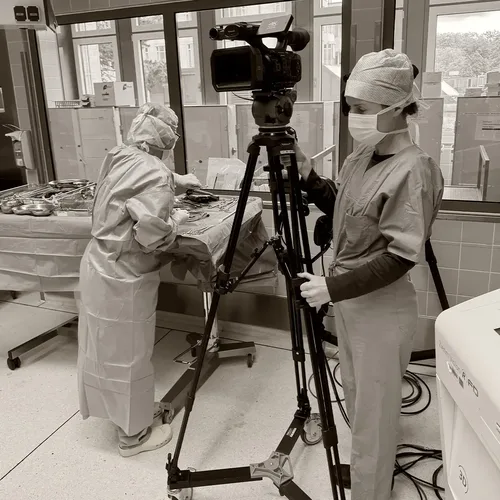
Camera operation in the operating room is a discipline of its own. The objective is not to create attractive images. The objective is to show the right images.
The audience in the lecture hall must be able to follow the procedure from a medical perspective. This means the surgical field must remain visible. Not the surgeons’ heads. Not shoulders. Not obstructed views. Only what is medically relevant.
During this particular transmission, camera work was especially demanding. Two surgeons were operating on two feet simultaneously. The camera position had to be adjusted repeatedly to maintain a clear view of the relevant surgical area.
The intense and highly focused operating lights add another challenge. Even small movements can require adjustments to contrast, focus and framing. Maintaining image quality demands concentration over long periods.
Sometimes it also requires physical endurance – for example, when a camera operator must wear a heavy lead apron throughout a lengthy procedure involving X-ray imaging.
Present without being disruptive
The operating room follows different rules than a conventional production environment. Technology must support medical workflows without interfering with them.
Important questions need to be answered in advance. Where can cameras be positioned? Which areas are sterile? Which pathways must remain accessible at all times? What restrictions apply to the technical crew?
In an operating room, even small mistakes can have significant consequences. Accidentally touching sterile equipment may require parts of the operating area to be re-sterilised and prepared again. This costs valuable time and disrupts a process that depends on concentration and precision.
Close coordination with the surgical team is therefore essential. Operating room nurses play a particularly important role because they understand the workflows, requirements and limitations of the environment better than anyone else. Listening carefully and respecting their guidance creates the foundation for smooth collaboration.
At the same time, the camera operator must represent the interests of the audience. If the surgical field becomes obstructed or an important action is no longer visible, this needs to be addressed politely and professionally. Often, a small adjustment to camera position or working area is enough to restore visibility.
One principle always remains unchanged: patient safety and the uninterrupted progress of the operation take priority over everything else.
What the audience sees – and what they do not
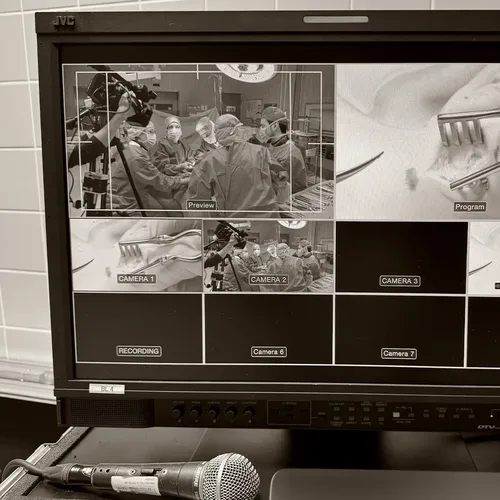
During a live surgery broadcast, the audience only sees content that is relevant for medical education.
Patient preparation, faces, personal information and any identifying details are never shown. Names are never mentioned. The live transmission typically begins only once the actual procedure starts.
Depending on the surgery, viewers may see:
- Camera images of the surgical field
- Endoscopy signals
- X-ray or angiography images
- Ultrasound images
- ECG and other medical monitoring signals
- Multi-source layouts, such as picture-in-picture views
The goal is not maximum exposure at any cost. The goal is to provide meaningful, respectful and educational insight.
The lecture hall receives exactly the information required to understand the procedure. Anything private or medically unnecessary remains off screen.
Why this environment is mentally demanding
An operating room is not a neutral production environment. Blood, medical terminology, sterile clothing, concentrated teams and confined spaces are all part of the experience.
Anyone working in this setting needs to understand that it is not a typical production assignment. An interest in medicine is helpful. A basic understanding of terms such as lateral, medial or distal can also be valuable, allowing camera operators to anticipate where attention is likely to shift.
At the same time, the work must be carried out with the same professionalism as any other production. No unnecessary movement. No distractions. No rushed behaviour.
In this environment, routine does not mean becoming indifferent. Routine means confidence and control.
Medical education requires expertise and sensitivity
Hospitals quickly recognise whether a technical team belongs in this environment. Experience, professionalism, reliable logistics and flexibility are essential. Equally important is a result that delivers genuine value to the audience.
Setup and dismantling windows are often short. Existing in-house systems frequently need to be integrated into the production. Despite these constraints, the transmission must remain stable while placing no burden on the medical workflow.
Ultimately, only a few questions matter:
- Can the audience see what is important?
- Is the speech clearly understandable?
- Does communication between the lecture hall and the operating theatre work smoothly?
- Can the procedure be followed and understood from a professional perspective?
When the answer to these questions is yes, a live surgery broadcast has achieved its purpose.
Not because the technology takes centre stage, but because it enables medical education in a way that is safe, understandable and respectful towards the patient, the surgical team and the procedure itself. A livestreamed operation is not about showing as much as possible. It is about making the right things visible.
Planning a live surgery broadcast?
Reliable live surgery broadcasts require experience, composure and the right equipment. We bring all three – as a coordinated team with compact systems and proven experience in surgical environments.
Get in touch if your medical live transmission needs to work flawlessly.