
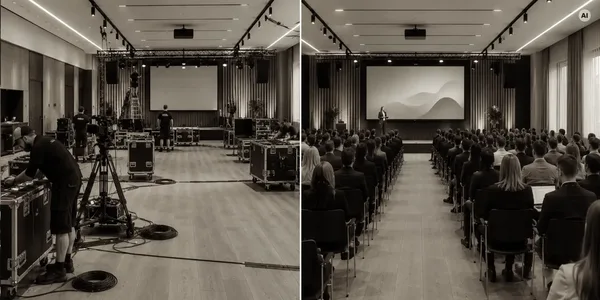
An audience member rarely sees more than the operator at the mixing desk, and maybe someone with a radio walking through the room. What they don't see: the far larger number of people working behind the scenes to keep sound, lighting, staging, and the schedule running together. That invisibility is exactly what causes regular surprises during budget planning – when the calculated crew size doesn't match the actual scale of the event.
In practice, a rough rule of thumb has taken hold: for every 50 to 100 attendees, at least one additional specialist should be planned for, as soon as more than one discipline – say, sound and lighting at the same time – needs to be handled professionally. Anyone planning a conference for the first time without an agency tends to underestimate this staffing need the most: the technology itself often looks manageable, but it's only once setup, live operation, and teardown come together that it becomes clear how many hands are needed at once. This rule of thumb doesn't replace an actual calculation, but it does give a realistic sense of scale as early as the first proposal stage.
How many technicians does a conference need?
- Technical director (TD) – holds overall responsibility for all technical disciplines, coordinates between client, venue, and team, and is the main point of contact for safety questions and last-minute changes
- Discipline leads – one person each for sound, lighting, video, and staging, each independently managing their own area and reporting to the technical director
- Operators – run the equipment during the live event itself: mixing desk, lighting desk, production control, camera
- Hands – handle setup and teardown, moving equipment, and support the discipline leads with rigging and cabling
- Certified event technology specialist – the recognized professional qualification that many hands and operators hold in the background; it covers planning, setup and teardown, and safety responsibility
How big does the technical team need to be?
There's no one-size-fits-all number – crew size depends on room size, format, and technical complexity. As a rough guide:
- Small conference (up to 100 attendees, one room, standard sound setup): usually 2–4 people – one operator handling sound and lighting combined, one hand for setup and teardown, plus a stage contact if needed
- Mid-size conference (100–500 attendees, multiple breakout rooms, livestream): usually 6–12 people – a technical director, one operator per discipline, additional hands for side rooms and the streaming team
- Large conference or congress (500+ attendees, main stage, multiple side rooms, interpretation technology): 15 up to well over 30 people – a technical director, several discipline leads with their own teams, interpretation technology support, a streaming production team, and additional hands for logistics
These figures are guidelines – the exact crew role distribution only becomes clear from the actual run of show, the number of parallel program items, and the level of live production involved (camera direction, streaming, simultaneous interpretation).
Want to stay in the loop?
Subscribe to our newsletter.
What has the biggest impact on staffing needs?
- Parallel program items – every additional breakout room needs at least one dedicated specialist on site
- Live production – streaming, recording, or camera direction increase staffing needs far more than standard in-person technology
- Interpretation and conference technology – multilingual formats need extra support for language channels and interpreter booths
- Setup and teardown time – a tight window between venue handover and the start of the event requires more hands working at once
These four factors together determine the actual role distribution – not attendee numbers alone.
In-house crew or freelancers – which makes more sense?
Very few companies keep a full technical team on staff year-round. In practice, a hybrid model has become standard:
- Core team – the technical director and discipline leads are usually permanent staff – they know the venue, the client, and the run of show in detail, and carry responsibility across the whole production
- Freelance hands and operators – for the actual setup and teardown, as well as individual operator roles, the crew is often scaled up as needed through freelance networks. This keeps costs flexible but requires enough lead time – good event technology specialists get booked out weeks in advance during peak season
- Budgeting the cost share realistically – specialized technicians often make up 30 to 50 percent of the total cost of a professional production. Factoring that in early avoids unpleasant surprises just before the event
Conclusion
The visible tip of a conference – the stage, the microphone, an operator at the desk – is only a fraction of the actual staffing calculation. How many technicians a conference really needs depends less on attendee numbers alone than on the number of parallel program items and the level of live production involved. Anyone who works out the right crew size early on with an experienced event technology partner avoids both being understaffed on the day and paying unnecessary extra costs for an oversized team.
FAQ
It depends on size and format: small conferences often need just 2–4 people, mid-size formats with multiple rooms need 6–12, and large congresses with livestream and interpretation technology can require anywhere from 15 to over 30.
The technical director (TD) holds overall responsibility for all technical disciplines, coordinates between client, venue, and team, and is the central point of contact for safety questions and last-minute changes to the schedule.
Hands handle setup and teardown, moving equipment, and rigging – their work happens mostly outside the live event itself. Operators run the equipment during the event, at the mixing desk, lighting desk, or in video production.