

A good congress feels effortless.
Guests arrive, quickly find their seats, music is already playing on stage, the first presentations appear sharp on the screens and every word can be understood – even in the farthest corner of the room.
Everything feels calm.
Almost natural.
But this feeling rarely happens by chance.
Behind a professional congress, there is usually far more technology, planning and coordination than visitors will ever notice.
Modern congresses are no longer just about a stage, microphone and projector.
They are an interplay of audio, presentation technology, control room setup, lighting, signal management and hybrid solutions for streaming or digital participants.
The larger the event becomes, the more important the technical planning behind the scenes becomes.
Why planning determines the overall impact
A congress consists of dozens of small moments.
The first speaker enters the stage.
A presentation starts exactly on time.
A panel begins without hectic changeovers.
Questions from the audience are clearly understandable.
The livestream runs reliably.
For guests, this later feels simple.
In reality, there is often a precise technical schedule behind it, where many systems have to work together at the same time.
Modern congresses are much more complex today than they were a few years ago. In addition to presentations, hybrid participants often need to be integrated, camera images transmitted, presentations controlled or content streamed live.
That is why professional congress technology does not begin with setup – it begins much earlier: with planning.
What event technology does a modern congress need?
The basic technical setup of a congress usually includes audio and microphone technology, loudspeaker systems, presentation and video technology, lighting technology, control room and signal management, as well as streaming and network technology for hybrid formats.
A central media check-in is also standard at many congresses today. It ensures that speaker content is checked early, coordinated and safely integrated into the technical schedule.
Which systems are actually needed depends on the room size, number of participants, event schedule and technical requirements.
For larger formats, early technical planning is worthwhile so that stage, sound, video, streaming, presentations and control room operations work together smoothly.
Audio & microphone technology
Many visitors hardly notice the sound consciously.
Until it becomes bad.
As soon as speech becomes tiring to listen to, an audience loses concentration surprisingly quickly.
A microphone with interference.
Echo in the room.
Panel discussions that are hard to understand.
Small issues immediately change the overall impression of an entire event.
Professional audio technology therefore does not simply make something loud enough. It ensures that speech feels pleasant and clear.
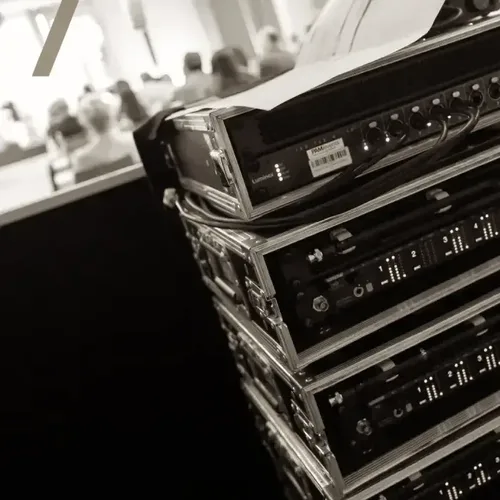
Wireless microphones, headsets, audience microphones and digital mixing consoles are often used, allowing flexible responses to different situations.
This becomes especially important for panels or hybrid congresses. After all, not only the guests in the room need to understand everything — the participants in the stream do too.
Presentation & video
Almost everyone knows this moment:
The presentation is supposed to start.
The speaker clicks to continue.
Nothing happens.
Suddenly, a professional talk turns into a hectic situation.
That is why a stable media technology setup is one of the most important elements of modern congresses today.
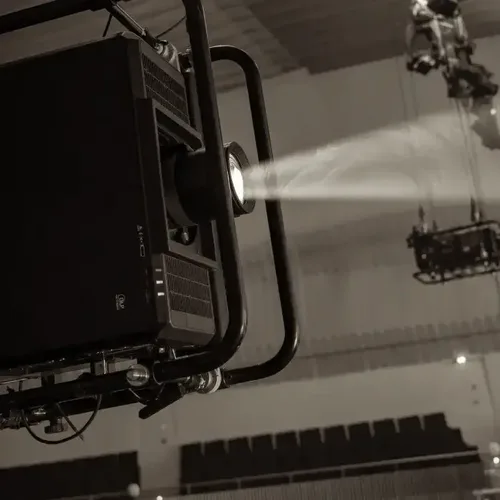
Professional events often work with prepared signal paths, preview monitors, media servers and central control.
This makes transitions feel calm and natural — even when many technical processes are running in the background at the same time.
Especially at larger congresses, additional camera and video technology is often used. It brings speakers onto large screens, enables livestreams or ensures that participants in the back rows can see every detail clearly.
Control room & signal management
The most important technology at a congress is usually located where hardly anyone looks:
at the back of the room.
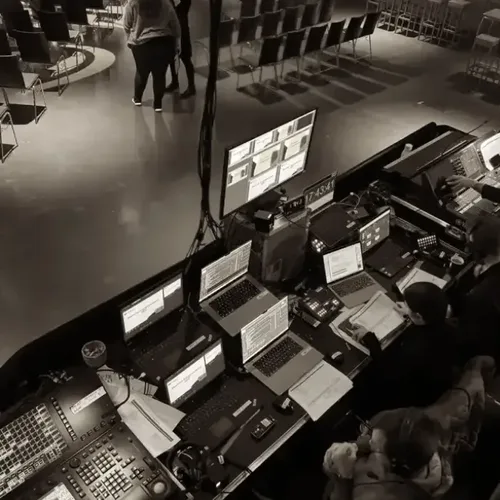
In the control area.
This is where presentations, camera images, audio, streaming and communication come together. While discussions take place on stage, the technical team often coordinates dozens of processes in the background at the same time.
Signal management ensures that content appears in exactly the right place at exactly the right moment.
Modern events consist of many different sources today:
laptops, cameras, displays, streams, presentations or LED walls all need to be connected reliably.
When it works, hardly anyone notices.
When it does not, everyone notices immediately.
Small and large congresses differ more than many people think
Not every congress requires the same technology.
Not every congress needs the same infrastructure.
A compact business event with one stage works completely differently from a multi-day professional congress with multiple rooms, livestreams and parallel sessions.
Smaller events often rely on flexible and compact technical solutions.
Larger congresses usually require extensive signal management, multiple control rooms, complex network technology and additional video production.
The deciding factor is not only the number of participants — but above all the complexity of the event schedule.
Don’t want to miss anything?
Then subscribe to our newsletter.
Technology for hybrid congresses: what matters
Hybrid congresses must work in two ways today: for guests in the room and for participants online.
That is why it is not enough to only plan the stage and microphones on-site properly. Camera images, audio transmission, streaming, presentations and stable internet connections also need to work together smoothly.
It is especially important that online participants do not feel like second-class viewers. They need to hear speakers clearly, see presentations properly and follow discussions without major delays.
A hybrid congress therefore requires technical planning that considers both the room and the stream together.
Good technology starts long before the event
Many technical problems arise long before the first congress day.
Not during the show.
But weeks earlier.
Presentations were never tested.
Streaming requirements were discussed too late.
Microphones do not fit the event schedule.
Signal paths were never fully checked.
For guests, this later looks like a technical problem.
In reality, the issue often begins much earlier:
during planning.
Good congress technology is hardly noticeable
A successful congress depends on everything feeling professional, calm and natural.
That is exactly what modern event technology creates.
It creates clarity.
Atmosphere.
Dynamics.
And trust.
Because when guests can focus entirely on the content without thinking about the technology even once — then the congress has been technically implemented really well.