
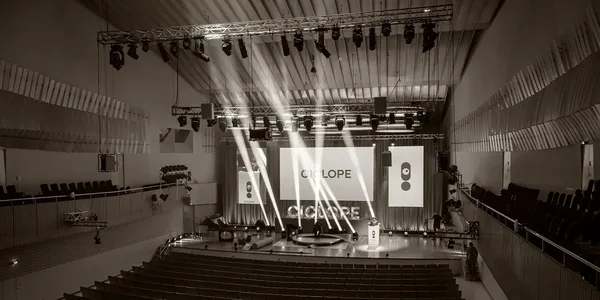
Light has an effect — even when people don’t consciously notice it
Lighting is one of those disciplines people rarely talk about actively — at least as long as everything works.
And yet, it plays a major role in how an event is perceived:
- Do spaces feel open and generous, or tight and cramped?
- Does a stage stand out, or does it lose its impact?
- Are messages easy to take in, or does the visual impression feel restless and unclear?
This is exactly where lighting makes the difference.
In a professional event context, lighting is therefore not just “illumination.” It is a central tool for shaping perception.
What good event lighting actually does
At its core, lighting serves three key functions at events:
Orientation
Guests intuitively understand where the focus lies.
Stages stand out clearly, and pathways are easy to recognize.
Important areas are visually prioritized and guide people through the space.
Without orientation, even strong content can feel unsettled.
Orientation
Guests intuitively understand where the focus lies.
Stages stand out clearly, and pathways are easily identifiable.
Key areas are visually prioritized and guide guests through the space.
Without orientation, a sense of unease sets in, even with great content.
Dramaturgy
Lighting controls the atmosphere and transitions.
Program elements are clearly separated from one another.
Suspense can be deliberately built up or intentionally reduced.
This is especially crucial for maintaining attention during long events.
Image Quality
Today, lighting must work for both the venue and the camera. It directly influences how professional an event appears.
Color temperature, shadows, contrast, and even illumination must be precisely balanced.
Mistakes become immediately visible in the stream.
Technology evolves — and so do the requirements
The demands placed on lighting have increased, while the technology itself has become far more powerful.
Multifunctional systems
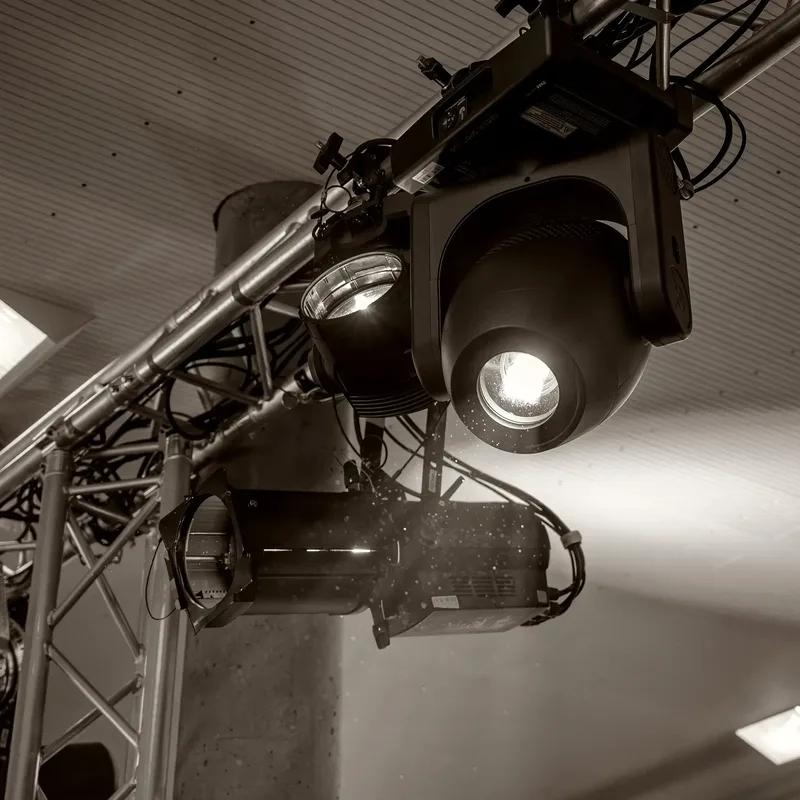
Modern fixtures combine multiple functions: spot, wash, effects, or pixel-precise control.
The result: more compact setups with a higher level of creative quality.
Less cabling, more flexibility
Battery-powered fixtures and wireless control significantly reduce the amount of cabling required.
That means:
- faster setup
- easier adjustments during live operation
Indoor and outdoor without compromise
IP-rated systems make it possible to create consistent concepts, whether an event takes place indoors or outdoors.
This simplifies planning and increases operational reliability.
Don’t want to miss anything?
Then subscribe to our newsletter.
Lighting at hybrid events: what matters
In hybrid and digital formats, the role of lighting has changed significantly.
It is no longer just about how the light looks in the room — it also has to perform well on camera.
What matters most:
- natural, consistent color rendering
- soft shadows on the face wherever possible
- sufficient contrast without losing detail
- even illumination across larger areas
Mistakes are far more noticeable in a livestream than on site.
At the same time, good lighting plays a key role in how professional the overall production is perceived.
Lighting design does not begin at the end
Planned too late
Lighting is often only considered once the stage, room layout, and event flow have already been finalized.
At that point, lighting usually has to react rather than actively contribute to the impact of the event.
The result: limited design options and avoidable compromises.
Planned early
When lighting is integrated early into the planning process, there are clear advantages:
- stages can be designed specifically around lighting impact
- rooms can be structured more clearly
- technical requirements can be solved more efficiently
The result: greater impact without additional effort.
You might also be interested in:
Conclusion: lighting as a structural element of the event
Lighting is not a decorative extra.
It is a structural element of every event.
It shapes how content is perceived, how people orient themselves in the space, and the overall professionalism of the production.
Today’s technology offers more possibilities than ever before.
The decisive difference lies in when and how consistently lighting is planned.